Home is where the habits are

About to start reading

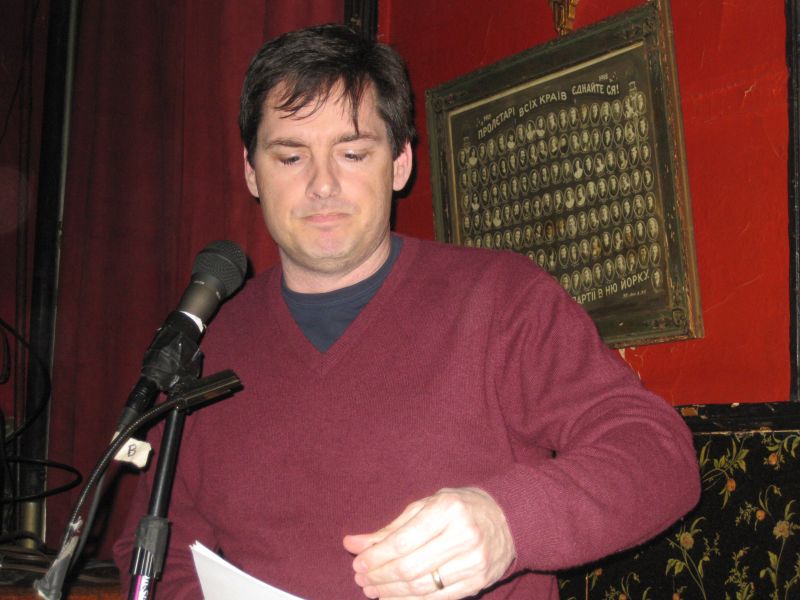
At the KGB -- picture by Ellen Datlow

It’s good to be home. After 10 days away, I realized that even when I’m enjoying myself — for example, living the high life in New York City, sipping sidecars at the Algonquin, drinking Belgian beers, going to a Broadway show, hanging out with my editor, lunching and brunching with various literary types — there’s a part of me that not only misses my usual rut, but wants to return to it as soon as possible. I want to lay down in it, and let the melting snow course down the back of my collar.

For one thing, my rut is where a lot of my favorite people hang out. Such as my kids. For another thing, it’s where I get all my work done. It’s this steady, boring pace — wake up, go to work, then come home and go out to write — that enables me to get words down on paper. Don’t knock boring.

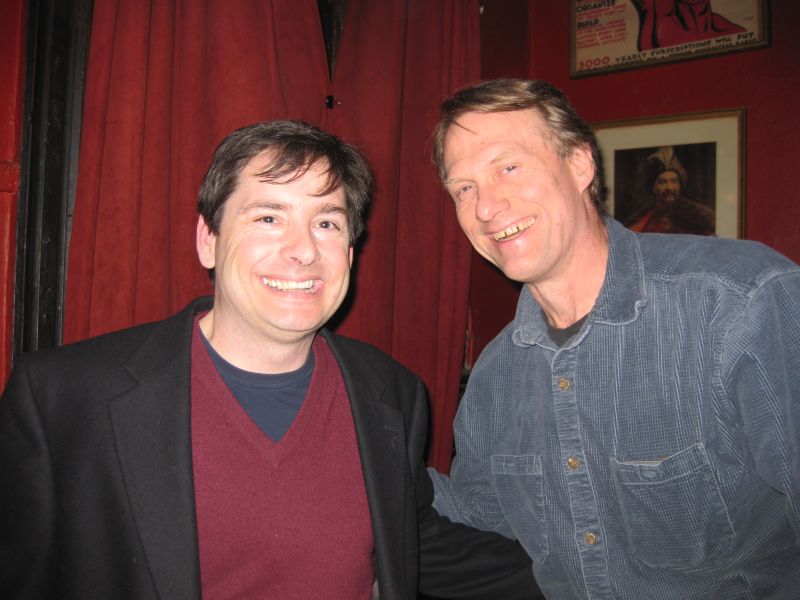
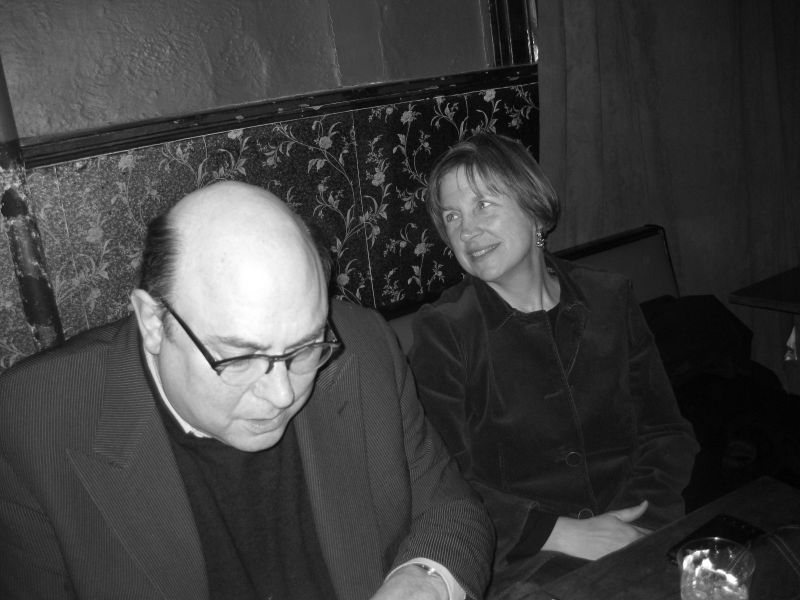
Peter and Kathy at the KGB

Peter and Kathy at the KGB -- pic by Ellen Datlow

And don’t knock New York. Reading at the KGB Bar was fabulous, and I got to realize one of my rock and roll dreams by yelling “Hello New York!” into a microphone before a hip Manhattan crowd. Peter Straub packed ’em in. Ellen Datlow and Matt Kressel were great hosts. People bought books, I got to see friends that I usually only see at cons, including Gary K. Wolfe, who was in from Chicago–just to see me, I’m sure). If you want to hear more about how I prepped for the reading, and how it went, see my post over at the Clockwork Storybook blog. Oh, and more pictures from the reading are on Ellen Datlow’s Flickr site.

And afterward, Ellen and Matt treated Kathy and I to the best Chinese food we’ve ever eaten in our lives. Seriously.

But the whole weekend was like that. We ate at Babbo’s (getting a table in the dining room even though we hadn’t been able to score a reservation), had lunch with the Asimov’s folks, Sheila Williams and Brian Bieniowski, visited MOMA, and had a killer lamb & pita sandwich from a street vendor. On the way out of town we crossed the Brooklyn Bridge and had brunch with Sam Butler and Susan.

Best New York moment, though? Passing a restaurant that advertised Pizza   Falafel   Ice Cream. Where else but New York?

When we got home on Saturday, I had one day to repack before heading south to Tennessee to see my folks. In a bid to trump anything I’ve done science fictionally, my father insisted on being operated on robotically. He came home without a minor organ, and only five little puncture wounds to show for it. He looks like he’s been worked over by Doc Ock, but now he’s doing fine.

But now I’m home. The rut is deep and comfortable, and won’t stay this way long, considering the eldest child is heading off to college this fall.

KGB -- with Brooklynite Sam Butler. (Yes, pic by Ellen Datlow)


In Russia, the Reading Comes to You

Suvudu has somehow gotten ahold of the transcript of my interrogation by the KGB. It was a huge misunderstanding. I”m reading at the KGB Bar, with Peter Straub, this coming Wednesday, Feb. 17, not trying to overthrow the Soviet Union. But you try explaining that to these guys. Anyway, if you’re in NYC this week, stop on down.

As for other appearances, in April I’ll be at Norwescon in Seattle for the Philip K Dick Awards, then in Medellin, Colombia for Fractal 10.  Evidently I like to hopscotch across huge geographical areas.

In other news, The Devil’s Alphabet made Locus Magazine’s Recommended Reading List for 2009. I’m pleased to be on in such great company, especially with friends of mine — Greg van Eekhout, Jack Skillingstead, Nancy Kress, Paolo Bacigalupi, and more. It’s slowly dawning on me that with so many friends on a roundup like this,  I’m not really an outsider anymore. Which is kind of an adjustment for me. My preferred position is stand on the sidelines and throw rocks at the adults. I may have to rethink my life.

Oh, and last night I reached the 60K word mark on the new novel. Only 30 to 40 thousand more words to go….

Sign, Monkey Boy, Sign!

Here’s a shoutout to all the people who showed up to the signing/reading/book launch party for The Devil’s Alphabet this past Friday. Thank so much, friends. And thanks to Danielle and everyone at the State College Barnes & Noble, who were so gracious and helpful. I very much appreciate y’all supporting a local writer of weird books.

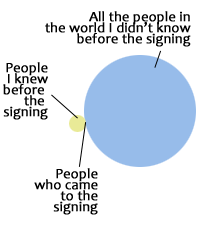
I think about 50 people showed up to bookstore portion of the evening, and we had about that many in our house afterward for desserts., though these two groups did not completely overlap:

True, I knew almost everyone, but that’s why insecure writers hold local signings. I’ve done a couple of these bookstore events outside my hometown, and in all cases they have been what I call Ego Correction Exercises. A roomful of friendly faces is a wonderful thing.

But I did meet a few new folks, including Nick & Phiala and Mike & Elizabeth, two couples who are SF fans and true geeks who could talk inside baseball like nobody’s business, and who all lived within two blocks of me. Which is one of the coolest things about living in a small town.

At the bookstore I started with a short reading from the book. I think it took me longer to explain the premise of the novel and set up the scene than to read the scene itself. Fortunately, the scene contained only medium amounts of description about pus.

This was followed by the traditional (because we did it for the Pandemonium launch), handing out of five “Questions written by My Wife” for people to ask during the Q&A section. Questions such as, “Rumor has it, you were a big whiner during the writing of this book. Please explain.”

I also got to talk about the cover, and demonstrate once and for all that those are not my eyes.

Then it was on to the signatures, then back to my house for dessert, coffee, and other beverages. Our friend Kimber made it to the house, straight from working as a clown at a birthday party, and freaked out my son, who has a thing about clowns. More pictures.

Can I just say how much fun I had? Thanks again for welcoming this book, people.

The Daryl News Network

Hi, it’s been nearly 4 hours. Would you like some more news about me, Daryl? Put on your best James Earl Jones voice and say it along with me: This is… DNN.

I’m trying to figure out what part of The Devil’s Alphabet to read at the Barnes & Noble signing this Friday. I don’t think it should be the scene where the main character helps three thugs drain pus out of his father. I’m just saying. If you’re curious to hear how this turns out, and you’re anywhere in central PA, please stop by — 6:30 Friday night.

Meanwhile, some reviews of TDA have been coming out. About a week ago Locus featured an interview with my friend Charlie Finlay, also known as Charles Coleman Finlay (to readers of his short stories), C.C. Finlay (to readers of his secret history of the Revolutionary War, with witches, known as the Traitor to the Crown trilogy), and Cuddles Finlay (to me, when I was feeling cold and alone one night at his Blue Heaven workshop). I really liked hearing why he chose a secret history over an alternate history for his books, and how Tim Powers influenced him. I can see it now, but I completely missed it when I read the books!.

Anyway, also in that issue of Locus is a review of my book, by Faren Miller. I found it interesting that she highlighted how much of a regional book this was. I liked this bit at the end:

Graduate thesis writers could probably find rich material for investigations of its allegorical nature, since the clades can be seen as exaggerations of various southern types: long, lean hillbillies; religious sects whose obedient women devote themselves to childbearing; and gluttons unacquainted with the concept of healthy food.

But Gregory doesn’t limit himself to parody, and major characters among the Changed can seem very real in both their memories of lost humanity and adaptation to their new conditions… Events in Switchcreek may also have wider implications for human evolution and the fate of the Earth itself, making this as much an innovative work of science fiction as it is an extraordinary exercise in regional literature, tinged with medical horrors.

And that pretty much says it.

Pretty much. Thanks to Google Alerts, I’ve been able to hear of a bunch of other reviews as they’ve come out:

Kel Munger of the Sacramento News and Review picked The Devil’s Alphabet as one of his top five fiction books (all genres) for 2009.

BW Fenlon, over at the Missions Unknown blog (staffed by various Texans of San Antonio, one of whom is a friend of mine, John Picacio) wrote a review of TDA.  He works at a San Antonio bookstore, and says, “It was the cover of The Devil’s Alphabet that initially drew my attention with its gloriously creepy upside-down eyes staring back at me every time I walked by.”  I definitely get a binary response on that cover. Some people, especially editors and booksellers, think it works. And some people really, really hate it. Even Mr. Fenlon, who liked the contents of the book, by the end of the review sounds a bit ambivalent about the cover: “One question I do know the answer to: I’ll definitely be on the lookout for more stories from Daryl Gregory, upside-down eyes or not.”

Ryan on the Battle Hymns blog recently wrote a nice (in both senses) review of Pandemonium.

The Barnes & Noble Online F&SF Book Club featured a two-person discussion on The Devil’s Alphabet. Okay, only two people, but I was happy to hear Paul and Ryan’s thoughts on the book. Thanks, guys.

Several nice reviews have showed up on Amazon.com from Moses Siregar (Moses stops by here a lot– hi Moses, thanks for posting that), Amanda Mitchell of SacramentoBookReview.com, and Amy Gwiazdowski of BookReporter.com (who really disliked the main character, but liked the book).

And on the GoodReads site, GoogleAlerts scooped up this review by someone named “Ellen”– who turned out to be the editor Ellen Datlow! She gave it 4/5 stars and said, “My only complaint is that I thought it was going to be darker than it is and so I don’t feel comfortable including it in Best Horror. (sniff)” My next assignment: Write something really dark for Ellen. Maybe I can finish it before I see her at the KGB Reading Series in NYC next month.

(You see how I slid that in there, mentioning again how I’m going to be reading at KGB? That, my friends, is the equivalent of a text crawl at the bottom of the screen. Next up: DNN Headline News.)

Distinguishing the Undistinguished

So this wonderful news arrived the other night: The Devil’s Alphabet is on the list of finalists for the Philip K Dick Award, the award for books published as paperback originals. The winner will be announced in Seattle at Norwescon on April 2, 2010.

When PKD died, Tom Disch founded the award in honor of the man.  As Locus puts it, “The awards were created and named for the writer who, though increasingly renowned after his death in 1982, was published mostly in undistinguished paperback editions during his career.”

Let’s hear it for undistinguished paperback editions!

I tried to trick my way onto the ballot last year by inserting PKD as a character in Pandemonium. Somebody told me that was the way to do it. Turns out, you have to write something that doesn’t mention Dick at all. (Insert mandatory Dick joke here.)

Seriously, I’m honored to be on the list, for a lot of reasons, but especially because several of PKDs books inspired me, and some of the previous winners and nominees include some of my favorite books. You can see all the covers of the books at SF Signal’s site. I swiped some of their html, because it includes the links to some of their reviews:

  • Bitter Angels, C. L. Anderson (Ballantine Books/Spectra)
  • The Prisoner, Carlos J. Cortes (Ballantine Books/Spectra)
  • The Repossession Mambo, Eric Garcia (Harper) [See SF Signal’s review]
  • The Devil’s Alphabet, Daryl Gregory (Del Rey) [See SF Signal’s review]
  • Cyberabad Days, Ian McDonald (Pyr) [See SF Signal’s review]
  • Centuries Ago and Very Fast, Rebecca Ore (Aqueduct Press)
  • Prophets, S. Andrew Swann (DAW Books) [See SF Signal’s review]

The Mug’s Game

Okay, so I finished a chapter of the new book yesterday, and Kath and Ian both read it.  (Kath’s the wife, Ian’s the son. Emma the daughter is too busy these days to read her dad’s stuff, though she wants to.)

The thing I appreciate about Kath as a reader is that she has zero tolerance for genre cliches, and she’s hyper attuned to interpersonal relationships. If I start shorthanding the relationships — basically, making the reader assume more than they should about how two characters feel about each other, or leaving blank what should be there, so that the action becomes impossible to interpret — she’ll call me on it.

Now, sometimes I ignore her. Sometimes I’m deliberately holding back on information on a character, or what one character thinks of another, to pay it off later. Sometimes I want the reader to lean in, to work for what the character is thinking. But, yeah, sometimes, I’ve just missed the boat.

As was the case in this chapter. There are two secondary characters who are inadequately fleshed out. One of them, I deliberately left mysterious. But the other, I thought I’d provided enough info so the reader could sense what their relationship was. I was wrong. Thank Jebus I’ve usually got time to rewrite, and I can fix this stuff before it goes out in the world.

Now Ian. Ian is thirteen, and he doesn’t give a rat’s ass about interpersonal relationships. He’s after the bang, and the comedy, and the action, and if I don’t deliver that, he will be ON me. In this chapter, he was happy to get some of the bang and comedy. (The bang is the thrill of the new. The comedy is self-explanatory. And action is plot, taking arms against a sea of troubles, etc.) Not much action in this chapter. This was one of those sections where I needed to load the bases hit by hit, so that expectation was built to a fever pitch…

But it’s a balancing act. I want, crazily enough, to satisfy everyone, everywhere, all the time. I don’t like to admit this. Writers aren’t supposed to care about their readers that much. And really, there is no way to please everyone all the time. It’s a mug’s game to try. But I’m a mug.

So, instead of writing the next chapter, in the next few days I’ll be going back over the last chapter, seeing if there’s a way to satisfy both those readers: a bang that means something.

I’ll let you know if I figure out how to do that.

Meeson’s Greetings

Oh, it’s almost Christmas, but for a needy writer, it’s always the Season of Me, and blog posts turn naturally to blatant self-promotion.

Signing at the State College Barnes and Noble — January 22, 2010 at 6:30pm.

If you’re in Happy Valley, stop by the local B&N (you know, the one out there by the mall). I’ll read a little from the book, answer your questions (or make you answer mine), and sign copies. Afterward, stop by my house for coffee and dessert! Directions at the reading.

Reading at KGB, February 17

And when it’s even colder out, I’ll be in New York City reading  with none other than Peter Straub at the KGB Fantastic Fiction Reading Series. Time to man-up!

Free Stories

My story “The Illustrated Biography of Lord Grimm,” which appeared in Year’s Best Fantasy 9, is available for free at the moment from Tor.com, along with four other stories: “The Film-makers of Mars” by Geoff Ryman, “Caverns of Mystery” by Kage Baker, and “Lady Witherspoon’s Solution” from my State College, PA compatriot, James Morrow. And you can download three more stories from that anthology, too.

You do have to create a tor.com account first. I ran into a hiccup where the site lost track of my request after I created my account, so I suggest creating the account first, then clicking the link.

Fictional FrontiersOn the frontiers of radio

Sohaib from Fictional Frontiers had me on his radio show a couple weeks ago, and I had a great time yet again — he was an enthusiastic supporter of Pandemonium. You can listen to or download the interview on their archive site.

A couple more reviews

These hit my in-box this week, courtesty of google’s ego surf tools:

From Sean Melican at Book Page: “More subtle than some SF novels, The Devil’s Alphabet is an absolutely stunning, intoxicating blend of vintage mystery, science fiction and intergenerational saga which artfully questions the meaning of what it is to be ‘human.’”

From Amy Gwiazdowski at BookReporter.com: “Daryl Gregory has an engaging writing style, and while I didn’t care much for Pax [the main character], he infused the book with enough interesting turns to keep me reading. I found myself wanting to know more about the residents, what happened to them, and why they changed.”

So that’s it for me, for now. How are you doing? Oh wait, hold that thought, I see someone on the sidewalk who may not know about me. Gotta go!

Does Cross Posting Mean I’m Angry?

And is a cross-dresser upset about their wardrobe?

Just some notes about things going on in the world of Clockwork Storybook. Awhile back I mentioned that I joined this august collective of multimedia writers (I think I’m the only monomedia guy there), and we use the blog to talk about what is known among the pretentious as “matters of craft” — AKA, the writing biz. I just wrote a post called Iron-Clad Scrooge about the bullet-proof narrative structure of “A Christmas Carol. ” Really, there’s seems to be no damage you can wreak on this story that will derail it.

But more fun than my post is what my Clockwork cohort Paul Cornell has put together. On his blog, he’s hosting “The Twelve Blogs of Christmas,” and Day 8 is a  cheesy 1960’s Christmas special co-written by all the Clockwork folks. Enjoy.

Good reviews aren’t necessarily positive

Update 12/14/09: Gary K. Wolfe’s review is now online.

Today I read two reviews of The Devil’s Alphabet, one by Karen Burnham at SF Signal, and the other by Gary K. Wolfe at Locus (printed on actual paper). Both were pretty positive — Wolfe starts the review calling me “amongst the most interesting of the newer writers to emerge in the past decade, and rapidly becoming one of the most unpredictable,” which is nice, and Burnham gives me 4/5 stars — so I’m not complaining. But what I most appreciated was the thoughtfulness of the reviews.

Gary Wolfe is pretty much the dean of SF critics, the reviewer I’ve been reading the longest, and the person I most wanted to be reviewed by when I started writing novels. When I get my copy of  Locus, I read his column first, every issue. He’s such a good writer that I find it difficult to disagree with him, even when I don’t agree with him. So it was with some sense of trepidation that I read his review — if he said I sucked, what was I supposed to do with that massive cognitive dissonance?

Karen Burnham has been reviewing for a couple years, and when I met her at a convention a couple years ago, I was immediately struck by her excellent taste — because she immediately told me she liked my short stories. She hasn’t been reviewing enough lately — she’s works for frickin’ NASA, for crying out loud, so her day job’s a bit busy — but her review of Pandemonium last year pointed out something I hadn’t been conscious of, that you could read the story as one family’s struggle to take care of someone with mental illness. It’s the mark of a good review that afterward you think, damn, maybe that IS what I meant.

So, two reviews in one day. Wolfe (I’m going to call him Wolfe, because in his review he uses my last name, like reviewers do) pointed out that while Pandemonium was a mash-up of content, Devil’s Alphabet was a mashup “of form and genre.” Then he goes down the line sighting echos and references that seemed to have informed the book, all of which made me think, damn, he must be right.

On the one hand, the novel hovers around a sort of evolutionary hard SF of novels like Greg Bear’s Darwin’s Radio… on the other, it returns to an earlier kind of evolutionary SF that we’d seen in novels from van Vogt’s Slan to Sturgeon’s More Than Human, in which the focus is more on the pariah status of the victims than on the biological puzzle, and on the inability of the larger society to cope meaningfully with the implications of the event. But then again, it’s also a homecoming tale about a young man (unaffected by “the Changes”) who has escaped his rural origins for a life in Chicago. Finally–and this is what drives the novel’s main plot–it’s a small-town southern Gothic murder mystery. No one can accuse Gregory of being a one-note author.

Wolfe then goes on to describe the overstuffed plot, and says, “While Gregory does an impressive job of keeping all these plates spinning without losing his narrative’s coherence, there is still a sense that a bit much is going on all at once, and that some of those plates are starting to wobble.”

This is definitely something I struggled with while writing the novel. How to pay off all those plot lines? How to keep them in balance? I think it’s something I’ll continue to struggle with. I was happy, though, to have him end the review with this:

The larger question, of what eventually might become of these evolutionary exiles as they move into second and third generations, seems to move us back into Theodore Sturgeon territory, and it’s fortunately a territory that Gregory has mastered well. The novel’s quiet ending, in a snowbound South Dakota winter, is haunting.

In Burnham’s (not Karen’s) review, which I won’t quote from as much, ’cause you can read it yourself, she points out something that is kind of my modus operandi — I try to wed a mainstream, character-driven story to sfnal weirdness. In fact, it’s pretty much all I’m trying to do, every outing.

But Burnham takes a couple paragraphs to do something that the best critics do — consider the work in context of a career. One, she doesn’t think Pandemonium or Devil’s Alphabet measure up to my short stories, and she’s particularly sad that neither book has a female character as the main protagonist, as some of my stories (her favorites of mine) do.

This is an interesting problem for me, in a couple ways: one, I don’t want to be writing the same characters over and over, and having the main protagonist always be young, white, and male is boring and a bit odd. (Besides, I want to stay as unpredictable as Wolfe thinks I am.)

And it’s not like I don’t like to write about women. Burnham mentioned some of the short stories, and in  the novels some of the strongest and smartest characters are female. In Devil’s Alphabet, as a reviewer on SFF World pointed out last week, most of the power structure of Switchcreek is female, led by Aunt Rhonda, the mayor of the town, who shares some of the POV duties in the book. But none of these women are the main character, as Burnham points out. So what’s up with that?

Now, I realize that this is a sample size of 2 novels, and hopefully I’ll have more opportunities to write more books. But the problem for me is that I don’t have much choice in these matters. When I wrote “Second Person, Present Tense,” the main character walked on stage, and she was a teenage girl. There was never any question that she’d be a boy. In “The Continuing Adventures of Rocket Boy,” I likewise knew that this was the story of two boys who were best friends. In “The Illustrated Biography of Lord Grimm,” the welder and minion of the supervillain was always going to be a woman– and so on, for every story.

With secondary characters, I have a bit more leeway. They’re more vaguely defined in my subconscious, so when they walk on stage I can ask myself if they’d be more interesting, and better for the story, as female or male, gay or straight, of color or not. But with main characters, they pretty much arrive as-is, with no refunds, packed alongside the idea that carried them into my brain. Maybe it’s different for other writers.

So, will I ever have a female protagonist in a novel? I can’t believe I won’t at some point. If the short stories are any indication, some woman’s going to walk on stage with a novel-sized idea under her arm and demand to have her story told. I have to admit, though, that in the book I’m writing now, the main character is another guy. Maybe Book 4, then.
Small Beer, Small Baby, Good Books, Great Charity

Here’s something for the season: Gavin Grant and Kelly Link, owners of Baby Ursula! Small Beer Press, are holding a book sale to benefit The Franciscan Children’s Hospital, where their daughter Ursula (that’s her at left) stayed this year during the first months of her life. (Full story)

Pay full price and a big portion goes to the hospital — or pay the sale price and $1 is donated. Everybody wins.

Small Beer publishes wonderful books, including two I recently read: The Ant King and Other Stories by Benjamin Rosenbaum (surreal and unbelievably fun), and Generation Loss by Elizabeth Hand (frightening and beautifully written). As Gavin and Kelly say, Go wild!