Masked UnMasked

Howdy folks,

Believe it or not, as you read this I’m in the air, winging my way to Las Vegas for a writer’s retreat with the folks from clockwork storybook. I never thought I could feel so free. Flying away on a wing and a prayer…

Sorry. Greatest American Hero got stuck in my head there.

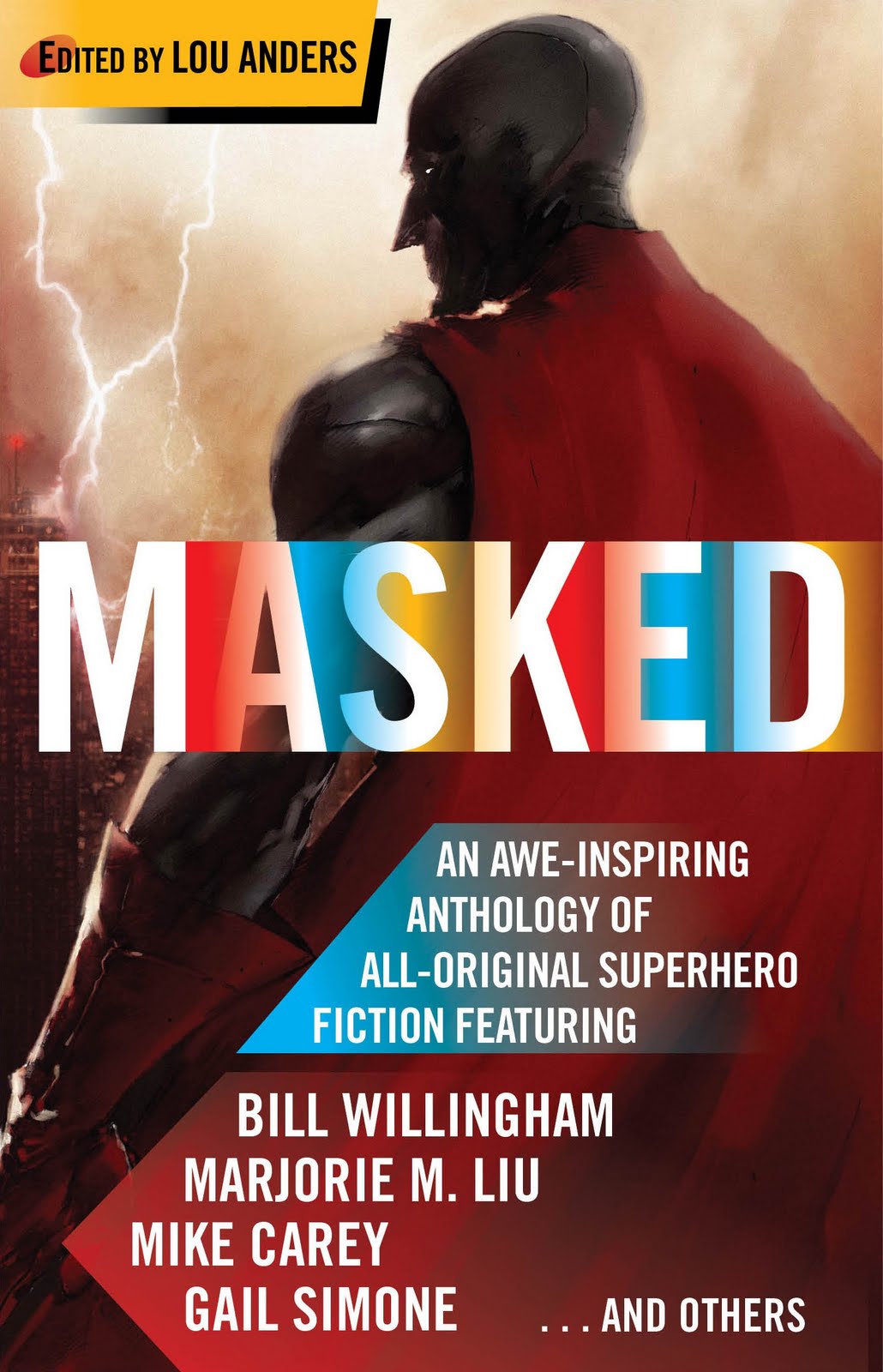
But speaking of heroes, let me tell you about a book that will be released in July that I’m so happy to be part of.  Masked is an anthology of superhero stories, all originals, written by comics writers, prose writers, and those that do both. My story’s there alongside those from some of my clockwork compadres Matt Sturges, Bill Willingham, Marjorie Liu, Paul Cornell, and Chris Roberson. (Yes, we are all over this book.) It’s edited by Lou Anders, who spends most of his time turning Pyr Books into the next SF/F juggernaut.

I love this cover -- by Brit artist Trevor Hairsine

Table of Contents

Introduction: The Golden Age by Lou Anders
“Cleansed and Set in Gold” by Matthew Sturges
“Where their Worm Dieth Not” by James Maxey
“Secret Identity” by Paul Cornell
“The Non-Event” by Mike Carey
“Avatar” by Mike Baron
“Message from the Bubblegum Factory” by Daryl Gregory
“Thug” by Gail Simone
“Vacuum Lad” by Stephen Baxter
“A Knight of Ghosts and Shadows” by Chris Roberson
“Head Cases” by Peter David & Kathleen David
“Downfall” by Joseph Mallozzi
“By My Works You Shall Know Me” by Mark Chadbourn
“Call Her Savage” by Marjorie M. Liu
“Tonight we fly” by Ian McDonald
“A to Z in the Ultimate Big Company Superhero Universe (Villains Too)” by Bill Willingham

And hey, it’s already available for pre-order on Amazon.

Monster Week

Hey, it’s Monster Week on Suvudu.com. I wrote a blog post on my favorite monster. One clue: It’s perfect creature for the attention-deficit-disorder generation.

Another?

It's a girl!

So please, people, take some time to give that monster in your life a bouquet of body parts, or whatever it is they most appreciate.

My close, personal friend, Juan Valdez

Jeremy Robert Johnson, Juan Valdez, and Me (photo by Vivi Trujillo)

Did I mention I went to Medellin, Colombia? Well I did, and now I’m back.Actually, I’ve been back for two weeks, but it’s taken me forever to write this post, and there’s _still_ more I could write about.

To answer the questions of my nervous relatives first: No one attempted to kidnap me. (Well, two local writers did, just for lunch, but it didn’t work out.)

Second, Juan Valdez exists. He’s kind of like Lassie, in that you don’t want to ask which Juan Valdez you’re with, or how many came before. On the other hand, the Juans last a lot longer than Marlboro Men. But he gave us all coffee! Which I’m drinking as a type this. Thanks, JV!

But I’m getting ahead of myself. Continue reading

Did I mention I came back from Norwescon? Well I did.

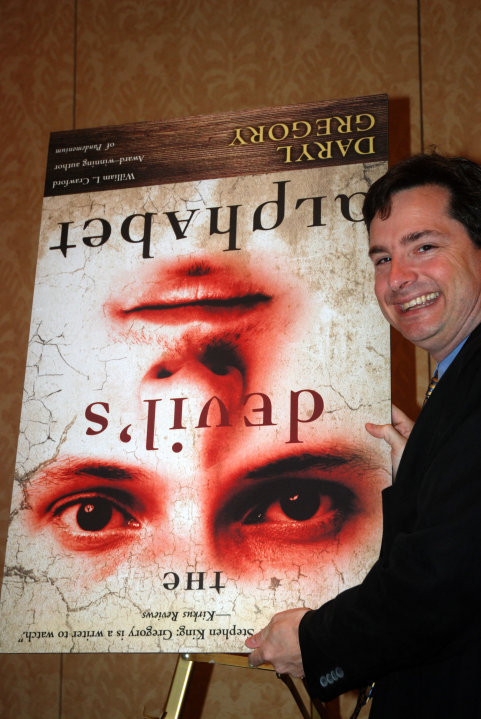
Daryl with some big eyesI’m way behind on this blog. I keep going on trips, coming back from trips, and then never sharing it here.

So, first things first — Norwescon! Way back in in the first weekend of April. No, the Philip K Dick Award was not mine to bring home — that award when to C.L. Anderson, AKA Sarah Zettel — but I did get to pose with a giant poster of my book (pic courtesy of Leslie Howle). Man those eyes are creepy. See below for a picture of the nominees, also from Leslie Howle.

Update! Don Glover, below, just posted a link to the youtube video of me reading an excerpt from The Devil’s Alphabet. Here me doing an imitation of my cousins’ accents (but trying not to overdo it).

I had a good time at the con, especially while hanging out with Leslie, Jack Skillingstead, Mark Teppo, Dave Williams, and bunches of other people, including some spankin’ new friends. (Though very little actual spanking got done.)  Norwescon is big on costuming, and steampunks were everywhere. More goggles than you could shake a brass stick at. Also? Corsets, corsets, corsets.

Next up, pics from my incredible to trip to Medellin, Colombia, for Fractal ’10! Stay tuned, citizens.

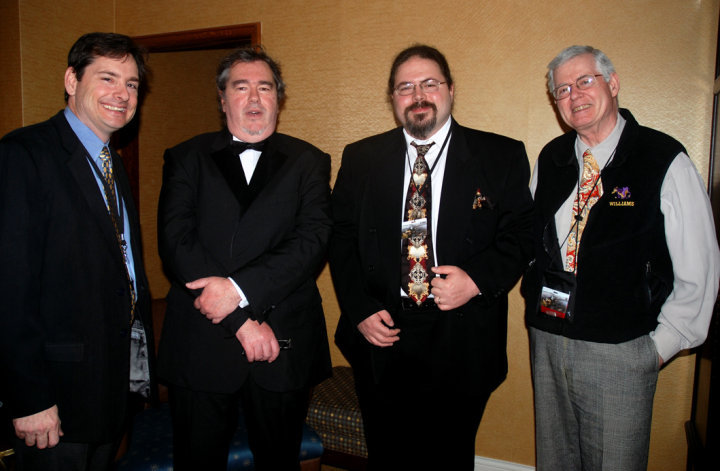
Next time I'll bring a tux

L-R: Me, Ian McDonald, S. Andrew Swann, and award administrator David Hartwell

Sleep-less in Sea-Tac

So next week I’ll be at Norwescon 33, which takes place in Sea-Tac. I’m embarrassed to tell you that I didn’t know Sea-Tac was its own town. I thought it was just the name of the airport. My apologies, Sea-Tackians. Sea-Tackites. Hyphenates.

Whatever the people there call themselves, they live amazingly close to Seattle, one of my favorite cities, and home to Cap’n Jack Skillingstead (see my review of his review a few posts ago), who will be my host. The Devil’s Alphabet is up for a Philip K Dick Award (the award that when you stop believing in it, doesn’t go away), but I’ll also be appearing on a bunch of panels, a lot of them with Jack. If you’re in the area (like, say, waiting to change planes) stop on by and we’ll try to put on a good show.

The schedule:

Thursday, 9:00 p.m., Cascade 8
The Living Dead

Forty years after George Romero gave us Night of the Living Dead, his zombies still walk among us in remakes, new films from Romero himself, andastonishing recent movies ranging from Shaun of the Dead to 28 Weeks Later. Zombies are cropping up in popular literature as well. Why is this SF/horror subgenre so enduring? What are its classic books and films and which are merely the walking dead?
Mark Henry (M), Daryl Gregory, Randy Henderson, Jack Skillingstead, Anthony van Winkle

Friday, 11:00 a.m., Evergreen 2
What is Consciousness?

How does the brain, with its diversely distributed functions, come to arriveat a unified sense of identity? As neuroscientists marvel at the patternscascading from their high-resolution brain scanners, they are nagged by amischievous question: who’s running the show? Can we speak of a person’s brain without, ultimately, speaking of the person? What is human consciousness? If the Singularity does happen, what will machine consciousness look like?
Janet Freeman (M), Daryl Gregory, Jason Henninger, Christian t. L. Mecham, Jack Skillingstead

Friday, 1:00 p.m., Cascade 5
Working On Your Craft: Writing as an Evolving Process

As with any other art, writing requires practice; and a writer’s skill can improve over time. Writers discuss techniques they have learned as they have evolved and ways in which they gained new levels of expertise. How can you tell when you’re improving? How can you judge your own progress as a writer?
Cat Rambo (M), Daryl Gregory, Eileen Gunn, Randy Henderson, Jack Skillingstead

Friday, 2:30 – 3:00 p.m., Cascade 3
Reading: Daryl Gregory “Becoming Digital,” Author’s note: the title doesn’t mean what you think it means., Rated: PG Daryl Gregory

Friday, 4:00 p.m., Cascade 4
Writing: The Long and the Short of It

Why are some people good at writing novels but not short stories or vice versa? What does it take for an idea to be `novel length?’ Are short stories just like novels only you finish sooner? Mary Rosenblum (M), Daryl Gregory, Eileen Gunn, Mary Robinette Kowal, Jack Skillingstead

Friday, 7:00 – 8:30 p.m., Grand 2
PK Dick Awards
William Sadorus (M), Carlos Cortes, Dr. John G. Cramer, Cory Doctorow, Daryl Gregory, David Hartwell, Ian McDonald, John Jude Palencar, Vernor Vinge

Saturday, 5:00 p.m., Cascade 8
Narrative Structure

Most readers read for story; but a story has to hang from a structure, and if the structure fails the story will collapse. The story’s structure dictates where the story starts, where it ends, where each of the plot elements fits, and charts the space in which your characters’ change and developments take place. Structure more than anything else will keep the reader’s eyes glued to the page to find out what happens next. Writers share how they approach narrative structure and plot.
Leslie Howle (M), Daryl Gregory, Ian McDonald, Cat Rambo, G.Robin Smith
Robots for your ears

Mail call!

A CD arrived in the mail the other day — actually, a box containing four CDs. If you’re in the mood to be read to — say, you have a long commute, or you’re having eye surgery — here’s a nice solution: “We, Robots,” an audio anthology edited by Allan Kaster. 270 minutes of excellent fiction about, well, robots, including my story, “The Illustrated Biography of Lord Grimm.” Mine’s mostly about politics and superheroes,  but it’s in there because the main character works in a supervillain’s robot factory. (Hey, we all gotta pay the bills.)

Buy it here!

As the box says, you get “seven contemporary robot tales written by some of today’s most acclaimed science fiction authors” read, unabridged.

  • A sentient war machine combs a beach for trinkets to create memorials for its fallen comrades in the Hugo Award winning story, “Tideline,” by Elizabeth Bear.
  • In “Balancing Accounts,” by James Cambias, a small-time independent robotic space tug is hired by a mysterious client for a voyage between two of Saturn’s moons.
  • “The Seventh Expression of the Robot General,” by Jeffrey Ford, involves a robot general coming to grips with his position in a world that no longer requires, or even understands, his role.
  • A city awakens its ancient guardian as it is about to be invaded by a mining company in “Shining Armour” by Dominic Green.
  • In “The Illustrated Biography of Lord Grimm,” by Daryl Gregory, a country ruled by a super villain comes under attack by American super heroes.
  • In “Sanjeev and Robotwallah,” by Ian McDonald, a young boy becomes enamored with the armed robots that do the fighting in a Civil War and the celebrity boy-soldiers who pilot them.
  • A robot acting as a scarecrow could be a desperate young boy’s one chance of staying alive in “The Scarecrow’s Boy” by Michael Swanwick.

Psychopaths Strike Back!

Look, I know I’m blowing your mind. Three blog updates in three days? What the hell is happening over there in Villa Del Daryl?

Year's Best SF and F by Rich HortonWell, the mail is happening, that’s what. A couple things — physical things, that required physical humans to carry them to my physical home — arrived in the past week, each embodying one of my stories in a new  form. But because I’m on this amazing, unprecedented roll in blog posting, I’m only going to talk about them one day at a time.

First of them was a book, The Year’s Best Science Fiction & Fantasy 2009, edited by Rich Horton. “Glass,” my story of psychopaths and mirror neurons and experimental drugs, is in there, alongside stories by some great writers — just look at those names on the cover. Hardly any of them are psychopaths.

To Explain or Not To Explain

I’m not sure how things got so out of hand, but yesterday I actually talked about a writer who wasn’t me.

Well, that won’t happen again.

Back to me, and my reviews. Black Gate Magazine has Mark Tiedemann’s review of The Devil’s Alphabet, called The ABCs of DNA and Other Thorny Themes. Full disclosure: Mark’s a friend of mine going back to when we were classmates together in ’88. We talk about once every two years (it’s  a guy thing), but in this review he seems to have peeked inside my head and grokked everything I wanted Devil’s Alphabet to do, and more importantly, not do.  For example, this part of his review:

Gregory lays out a rather interesting theory of why this may have happened, based on quantum tunneling and a facet of the many-worlds model of the metaverse. It may not be what has happened, he doesn’t go there, it’s just a theory, one among several developed by people who don’t know and who still need an explanation. It’s the human urgency for something rational, no matter how far-fetched, that is important, not the one of several Sfnal conceits that he may favor. Why and how this happened is less important than the fact that it has happened, and these people must deal with it.

Something I struggled with in the book — that I struggle with in every book — is the question of How much to explain? Explain too little and the reader feels ripped off. Explain too much and the whole story feels too pat, too tidy–too unrealistic. This is a balancing act that probably varies by reader.

Paul Witcover addresses this in his review of the book, which came out in the latest issue of Realms of Fantasy Magazine. Magazine staffer Doug Cohen handed me the issue when I was in New York a few weeks ago.

The Devil’s Alphabet again showcases Gregory’s talent for drawing inspiration from rock songs and comic books and employing it in new and inventive ways, and similarly, using these fantastic milieus to explore deeper questions about family and community. While there are a few loose ends still left hanging by the end of the story, the journey is entertaining enough along the way that most readers should be willing to overlook them.

And that’s the trick — will readers overlook them? As they say on teh internets, YMMV.

Oh, and while I’m here I should mention a couple more things about Me and My Book. TDA made the British Fantasy Award Long-List (and it is a long list). Thanks, British readers!

And the book also made SF Site Top 5 for 2009. (They usually do a top 10, but evidently the editors only overlapped on a small selection of books this year.)  And TDA squeaked in at #5. The Other 4:

4.  Julian Comstock: A Story of 22nd-Century America by Robert Charles Wilson

3. Destroyer of Worlds: Kingdom of the Serpent, Book 3 by Mark Chadbourn

2. The City and the City by China Miéville

and 1. Dust of Dreams: Malazan Book of the Fallen, Volume 9 by Steven Erikson

Thanks, SFS people!

Do You Know Jack?

So the other day my friend Jack Skillingstead got a fantastic review of his first novel, Harbinger, that appeared in the latest issue of The New York Review of Science Fiction. It’s one of those reviews that you want to put under glass and hang in front of your computer for those times when the sentences aren’t coming and you feel like drinking Robitussin from a five gallon drum. Or maybe that’s just me.

This is Jack

This is Jack

One thing I really liked about the review (besides the fact that it demonstrated how great the novel is, an opinion I agree with), was that the reviewer, Alvaro Zinos-Amaro, had read Jack’s short stories and found common themes and techniques, down to the sentence level. Comments like that give writers hope, because so often nobody mentions the sentences, even though they’re what stories are made of, and writers like Jack spend enormous amounts of time crafting those suckers.

Then–and this is the sweet part– Zinos-Amaro starts drawing comparisons between Jack’s prose and a certain iconic writer of the 20th century:

It’s only slightly slightly hyperbolic to claim that what Hemingway did for bull-fighting, Skillingstead is doing for sf tropes. He makes them truer than they have been by showing that they were false. … Skillingstead’s protagonists… seem to spend most of their lives in the tercio de muerte of a corrida, entering the ring of their experiences alone save for a muleta of disarming, almost lunatic charm and a sword of honesty that cuts inwards as often as it swings out.

The last sentence of the review is “Skillingstead is the matador of our field.” If I were Jack, I’d print that on a T-shirt and wear it under my clothes at all times. Or maybe just get it tattooed over my heart.

So take NYRSF’s word for it, and order the book.

More Daryl Talking to People

Forgot to mention a couple of interviews — because I must always be flogging the Daryl brand.

Recently I went on Tim O’Shea’s blog, Talking with Tim, and well, talked with Tim.  I love his blog. Tim talks to everybody — artists, singers, comic book people. He’s wide spectrum, baby. For my interview, we covered, among other things, my weird, almost-junior name, why it took so long for me to write a novel, and why I try but fail to get much humor into my stories.

And a few weeks ago, Moses Siregar asked me 7 questions, about the writing process, the hidden meanings in The Devil’s Alphabet, and threesomes. I responded with more or less 7 answers. I’m symmetrical that way. And Moses is just a cool guy who’s a new writer– you can tell he’s serious about this writing thing.

And now we cease our Brand Broadcasting day.