People who speak for me

Back when I was a high school teacher, I had a 40-minute commute each way, and I listened to a lot of audio books. Most were just okay. But I realized early on that when an audio book is terrible, it’s probably the book’s fault. No actor can save a bad book.

But when an audio book is great, it’s because they’ve found a great actor to go with a great book.

David MarantzWith the audio version of Raising Stony Mayhall, I felt extremely lucky to get David Marantz. He’s great–which means that if the book fails for you, it’s all my fault.

What I love about Dave’s performance is that his rich voice brings so much warmth to the book–which you really need in a novel that’s supposed to be about the nicest zombie in the world.

And Dave likes the book. My friend Marjie Nye pointed this out to me: Audible.com has a page for their voice actors to post videos about The Best Book I’ve Ever Narrated. Scroll down that page to see Dave’s entry about about why he dug Stony.  (Or, just buy the audible version!)

Tavia GilbertAfterparty will also be available from Audible.com. They just finished recording, and while I haven’t heard it yet, I’ve talked to the actor and I’ve got that lucky feeling again.

The fabulous Tavia Gilbert is narrating this one. She contacted me early on to clarify some pronunciations of names in the book, and we talked on the phone a bit about the main character Lyda and her alter ego Dr. Gloria: two voices, one brain. I’m psyched to hear the results, and I’ll post a link when the audio book’s available.

Update: The audible.com version of Afterparty is now available for preorder!

Kirkus joins the party

We were on the road yesterday, coming home from a quick Spring break trip to Tennessee to see my folks. They’re getting older, and I have to confess that I’m worried about my mom. She watched the entire three hours of “The Bachelor” finale. Obviously my sisters and I will have to take steps if this trend continues. I’m not looking forward to that moment that every child of older parents dreads: the day we’re forced to take away the remote.

Anyway, we were somewhere southwest of Winchester, Virginia with Number One Son behind the wheel (it’s good to have another driver in the family), when I checked my mail and got the news that Kirkus Reviews had reviewed Afterparty.

Now, Kirkus has the reputation for giving reviews that are… let’s just say “tough.” So I was relieved to see they’d given it a star. (“Awarded to books of exceptional merit” according to the website, which instantly put me in mind of Boy Scout promotion ceremonies. I want a badge!)

Anyway, the review’s not online yet, but here’s an excerpt:

Kirkus Star“This taut, brisk, gripping narrative, dazzlingly intercut with flashbacks and sidebars, oozes warmth and wit. A hugely entertaining, surprising and perhaps prophetic package that, without seeming to, raises profound questions about the human mind and the nature of perception.”

So that’s nice.

Cosmic Book News On Afterparty

A lot of news rolling in today. Like this review that just came in from Byron Brewer at Cosmic Book News. It’s pretty much what every writer hopes for. Also, Byron and I will also be doing an interview later.

Here’s a snippet from the review:

“It has been a long time since I have read a book of such wide scope, one that defies genre type such as Afterparty. Has writer Daryl Gregory (BOOM! Studios’ Planet of the Apes comic book series) given us another zombie romp, a superhero novella or a supernatural thriller for the ages?

“Yes, yes and yes.”

See what I mean? Now read the full review. 

Afterparty First Reviews

Greetings from the Rainforest Writers Village, in drizzly, misty, Quinault, Washington. It’s day one of this five-day retreat, in which I am supposed to sit in a cabin and write things. And oh, I’ve got a lot of things to work on — a comic script, a copy edit of the new novella that will come out this summer (more on that later), a few PR activities for the launch of Afterparty —  but mostly I’m here to start the new novel. I’ve just started stirring the primordial soup on the thing, which means that I will spend much of the next five days staring at the water and thinking about naps.

But, just before I was smuggled into the rainforest in the trunk of Jack Skillingstead and Nancy Kress’s car, I received word of the two first reviews of Afterparty. Here they are:

Publishers Weekly: “Gregory (Unpossible and Other Stories) dashes off his near-future story like a ‘chemjet’ printing out sheets of smart drugs…The tragi-comical satire dispenses with sermons and easy morals, preferring to be entertaining and thought-provoking instead.” Full Review.

RT Book Reviews: “Gregory’s world-building is top-notch… Afterparty is a story with hefty implications but Gregory wisely keeps the focus tightly on Lyda and her friends and ex-friends, giving the story as much emotional as conceptual impact.” (I’ll post a link when the April issue goes online.)

The Afterparty Tour

It’s on, people! When Afterparty launches on April 22, 2014, I’ll be making several appearances at cons and bookstores. Here’s the ones I can confirm, and there will be more coming.

Updated 3/17/14.  Portland and Seattle changed! (We found out that SFWA was doing its reading series on those dates, and I didn’t want to split the public with my fellow SFWAns, so a little joining forces [Seattle] and a little shuffling of dates [Portland]).

C2E2. Chicago, Friday, April 25; 1:30-2:30 PM, South Building, McCormick Place. A discussion panel on SF with signing to follow. C2E2 is a Chicago comic and pop culture expo. The panel is described thusly:
“From the far flung reaches of the Milky Way the mind-bending possibilities of time travel, let authors John Scalzi (The Human Division), Daryl Gregory (Afterparty), M.D. Waters (Prototype), and Mark Frost (the Paladin Prophesy series) tell you what they see when they venture to other dimensions.”

Barnes & Noble Oakbrook Center, Oakbrook, IL, Saturday, April 26, 2pm. My hometown bookstore! Or at least as close as we could get.

Powell’s Books at Cedar Hills CrossingBeaverton, OR, Monday April 28, 7pm. My first visit to Portland. Can’t wait.

SFWA reading seriesKirkland, WA, Tuesday April 29, 7pm. Seattle, my OTHER home town. I seriously want to move here. I’ll be reading with Nancy Kress, Jack Skillingstead, and Leah Cutter.

Copperfield’s in Petaluma, Petaluma, CA, Friday May 2, 7pm.  Just north of the San Francisco bay, this huge bookstore puts an emphasis on introducing authors to readers.

Borderlands Books, San Francisco, Saturday, May 3, 3pm. I love these people.

Mysterious Galaxy Books, San Diego, Sunday May 4, 2pm. And these people! Seriously, Borderlands and Mysterious Galaxy are two bedrock bookstores for the field. For writers like me, indie booksellers who know SF and fantasy are the difference between (career) life and death.

SF in SF Reading Series. San Jose, Thursday, May 15, 7pm. Free to Nebula Award Weekend attendees, $10 for others. All proceeds benefit the SFWA Emergency Medical Fund. I’ll be opening for Samuel R. Delany, new SFWA Grandmaster, and my teacher at Clarion back in ’88. Chip Delany was the teacher who had the most effect on my sentences, and is largely responsible for my first sale. Love this man.

I’ll also be attending these cons in 2014, and perhaps doing some reading and paneling:

I’ll have more news later, including details on a book launch party in State College, PA.

Party in the UK and Japan

Some good news: Afterparty will be translated into English. As in English English, which may include changing all my mid-word Z’s to S’s, as their organisations are wont to do. They also say wont a lot. The book will be published in the UK by Titan Books on August 18, 2014, which coincides with Loncon 3, the World Science Fiction Convention. We’ll be doing some kind of launch activity there. Many thanks to John Berlyne at Zeno Agency, who brokered the deal. He’s an absurdly tall man, but he uses his powers for good.

Soon after learning about the Titan Books deal, I learned that Afterparty would also be translated into Japanese. The books’ been picked up by Tokyo Shogensa, via Misa Morikawa at Tuttle Mori Agency. This is the first time I’ve had a book published in either country. So that’s cool.

The Spreadsheet of Shame

I used to have this idea that real writers could point to a deadline in the distance like Babe Ruth aiming his bat at the center field bleachers, and then, through the powers of professionalism, just start writing and hit that thing.

Turns, out, I’m no Babe Ruth. I can’t write a novel in one mighty swing. And there’s no urgency to a deadline twelve months away, or even six. I’ve found that the only way I can hit my deadlines (and I’ve hit every major one I’ve committed to, thank you braggy much) is to leverage daily amounts of shame. Or at least the risk of shame.

The best way to do this is to announce your goals — a daily word count, for example — to your loved ones and trusted colleagues, and have them ask you how it’s going on a regular basis. Say, every day at the dinner table. This is effective because we’re basically chimps, social animals evolved to respond to public opprobrium and approbation. (Cats don’t feel shame, which is why no one ever wants them on project teams.) 

But this daily confession can be wearing on your loved ones, and worse on your colleagues, because you keep calling during dinner. Wouldn’t it be nice if there was some device to make you feel that glow of approval, or that heat of disgrace? 

Which brings us to the Spreadsheet of Shame.

For every big writing project in the past five years, I’ve used an Excel sheet to track word counts. It’s gotten more elaborate with each project — because when you’re starting something new, one of the best ways to procrastinate is to work on something you tell people will make you more productive. This latest version has pretty graphs to show me when I’m falling behind, and cells that turn red when I’m under my goal.

For example, here’s what it looked like at the beginning of the writing of my YA novel:
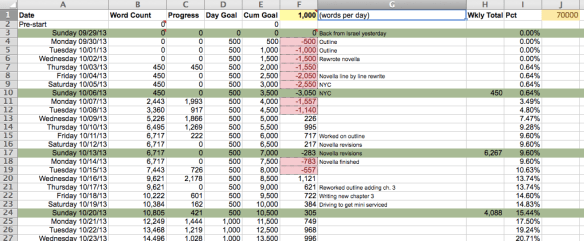
SpreadsheetOfShame Harrison Data

See all those red cells? I had a tough time getting started. That’s per usual. Also, notice that the goal in the first few weeks (that D column) was a lousy 500 words per day,  a rate that somebody like Tim Pratt would scoff at, and I still couldn’t match. Then I started catching up, and I ramped up my goals to 1,000 words a day, then 1,500.

There are a couple graphs I use to show my word counts each day, and how I’m stacking up cumulatively.
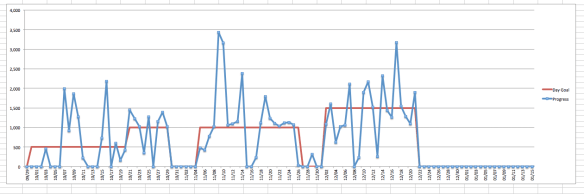
SpreadsheetOfShame Harrison Daily

SpreadsheetOfShame Harrison Cum

When things are going well — meaning, when that blue line is over the red one — I gaze upon these graphs in loving admiration. What a fine person I am! When that red line is above the blue one — and sometimes it’s way above — I beweep my outcast state.

Over the years I’ve shared the S.O.S. with a few writer friends, and now I’m sharing with you. If it helps you, fantastic. If it doesn’t, then use a more public form of shaming.

First, download it

At the start of your project, do this:
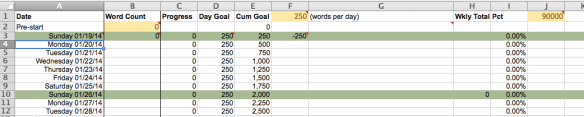
SpreadsheetOfShame Setup

  1. Save the file with a new name.
  2. Update the Data tab.
    1. In the Data tab, pick a start date. In A3, enter the next Sunday when you’re going to start tracking. It needs to be a Sunday.
    2. In B2, enter the number of words you’ve written before you started tracking. This can be zero.
    3. In F1, enter the number of words you want to write per day. (This is only the default amount — you can change individual days.)
    4. In J1, enter what you think might be the ending word count. This is only used to calculate the percentage complete in column I. It doesn’t affect the graphs.
    5. If you know you’re not going to write on some day — say, Arbor Day, because who works on Arbor Day? —  go ahead and put a zero into the cells for that day in column D.
  3. Set up the dates for the Daily graph.
    (Excel does not automatically make the dates on the X-axis of this graph, so you have to set them manually.)

    1. Click on the Daily tab.
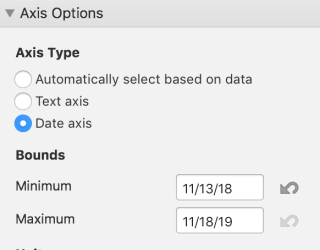
    2. Double-click on the X-axis of the graph (it may be showing only a single date, so click on that date). This brings up the Axis Options dialog. (Below is the Mac version–yours may look a little different.SpreadsheetOfShameAxisOptionsDialog
    3. Under Bounds, set Minimum to be the start date you entered in your Data tab (cell A3).
    4. The Maximum should automatically refresh to show the last date in your Data tab. If it doesn’t, manually enter it. (Cell A373)
  4. Set up the dates for the Overall graph.
    1.  Click on the Overall tab.
    2. Double-click on the X-axis of the graph. (This may be showing only one date.) This will open the Axis Options dialog.
    3. Under Bounds, set the Minimum to be the start date of the Data tab (cell A3)
    4. The Maximum should automatically update. If it doesn’t, enter the last date of the Data tab (cell A373).
  5. Optionally, change the Maximum wordcount on the Overall graph
    1. Double-click on the Y-Axis of the graph. This will open the Axis options dialog.
    2. Under Bounds, set the Maximum to 5,000 or 10,000 words above your desired wordcount. For example, if you’re aiming for 120K, set your Maximum to 130,000.
  6. Save the sheet!

Then every day, do this:

  1. In column B, enter the total word count in the doc. (All the other columns will update to show how many words you wrote that day, and what your % complete is.)
  2. In column G, you can leave notes about what you worked on that day. Or (and this is more common, in my experience) to explain why you didn’t reach your goal that day.

And that’s it. The other tabs are graphs to show your daily output, in, well, graphical terms. That’s why they call them graphs. They’re graphic.

Oh, yeah. When you start to fall behind,  column F starts turning red. That would be the shame aspect of the document. But really, it’s the graphs that make me realize when I’m slipping.

And hey, it’s only an excel doc, so you get to do anything with it you want.
First Responders: Afterparty is out!

Oh my, it’s leaking into the world. Afterparty, my next novel, won’t be published until April 22, but the ARC (Advanced Reader Copy, for you civilians) has been sent out. This is always a weird time for a writer. You’ve sent your darling off to kindergarten, and you hope the other kids aren’t making fun of her for those weird clothes you made her put on. (“But honey, all the genre kids LOVE neuroscience!”)

The first person to post is Rose Fox, editor at Publishers Weekly. This is Rose’s personal blog, and it’s not an official review, but it’s reassuring to hear the first reports. Rose read it in a day!

I’m down with A.R.C. Yeah, You Know Me.

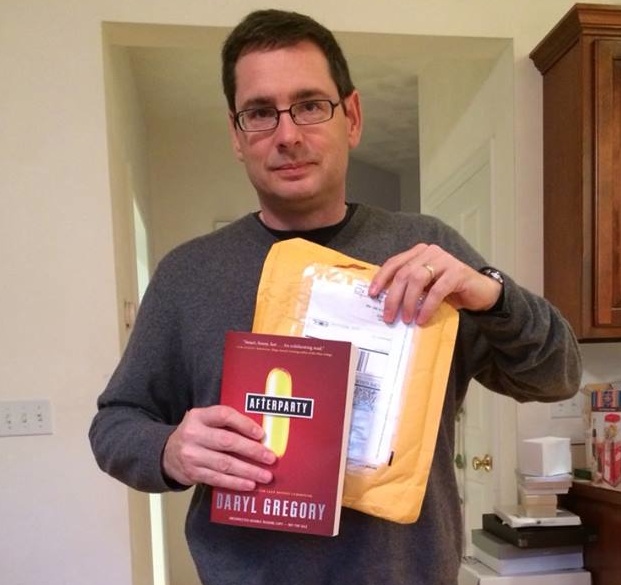
It’s always a nice moment when the Advance Readers’ Copy of a new book arrives. This time, Tor did a full-color ARC, and the deep red is beautiful to mine eyes. Though my hair isn’t. There’s something about this angle that makes me look like Marge Simpson. Give it up, Daryl. Enjoy the moment. Stop worry about your God damn hair. There are people in China who don’t even HAVE hair.

So. One step closer. May the reviewing Gods like this book.
AfterpartyArcCropped

Iain Banks

Iain Banks has posted a message on the Banksophilia website: he has terminal cancer, and his next book, The Quarry, will likely be his last.

I’m not much of a fanboy. I don’t follow the lives of writers. Meet too many of them, and you realize that if you love books, you’re probably better off not knowing too much about the people who create them. The stories are what matter, and they’ll always be there.

But this news has knocked me back. I first read The Wasp Factory, his first novel, back in college. My friend Nancy Neibur pressed it into my hands and said, “I think you’ll like this.” Oh Jesus did I. I’d never read anything like it.

Then, years later, I read Consider Phlebus, the first of his Culture novels, and was bowled over twice: once by the audacity of the book, and second by the fact that it was written by the same man who’d written The Wasp Factory. I don’t even like space opera, but here was a writer who’d reinvented it, jazzed it up, and made me turn pages in the way I did when I was ten. But this was entertainment for adult brains. The language and narrative structure were as much a part of the joy as talking spaceships.

I went back and got my own copy of The Wasp Factory, then proceeded to hunt down everything he wrote. When I went to England 16 years ago I made sure to find every book I couldn’t get in the US (this was in the pre-internet days, when it was tough to get UK versions), under both his names: He writes SF as Iain M. Banks, and “mainstream” as Iain Banks, though sometimes you’d be hard pressed to tell the difference.  In both modes he’s the master of the grand set piece, capable of wheeling out one seven-layer cake of strangeness after another. He is able to end a 700 page novel with a sentence that makes my jaw drop.

I don’t read him like a writer looking to steal his tricks.  I don’t read him critically at all. I read him like a fan. And at this stage of my life, after 25 years of writing, there are precious few people in that category.

Would anyone but a fan name his son “Ian”?

So Mr. Banks: You’re not dead yet, but it’s looking grim. Before you go, I just wanted to say thanks, and I’m looking forward to the next book.

Your fan,

–d