Librarians dig the Stony

The Library Journal just released their Top 10 Science Fiction and Fantasy books for 2011, and Raising Stony Mayhall made the list, along with books by some other guys. (This kid George RR Martin is supposed to be pretty good, I hear.)

Back in July, LJ gave Stony a starred review — but my Google alerts failed me, and this was the first I heard about it. Their review, in its entirety, was this:  “Part superhero fiction, part zombie horror story, and part supernatural thriller, this luminous and compelling tale deserves a wide readership beyond genre fans.”
In other review news, Paul Witcover just reviewed the book in Realms of Fantasy Magazine. The magazine is going out of business again (it’s happened a couple times before), but perhaps it will rise again, just like… but you know where I’m going with this. Here’s part of what Mr. Witcover had to say:

Richly imaginative, surprisingly funny, both grippingly and sensitively told, the novel is by turns nostalgic, grim, and redemptive. It’s also got real crossover potential, yet it will also satisfy the most demanding zombiephiles. This is a book that has brains… and eats them too.

Farewell, RoF — we hardly knew ye.

Cluting Stony Mayhall

But if it is a stricture to suggest that apophasis-ridden SF texts are time-wasters (I do mean to suggest that), then Wilson and Gregory are exempt…

That’s the logline, more or less, of John Clute’s review of Robert Charles Wilson’s Vortex and my book Raising Stony Mayhall. I love reading Clute’s reviews and essays, even when they’re not about me (and they’re never about me — this is the first), if only because I have to work so hard to figure out if I’m getting scammed. Is he serious? Is this a con job? Can a guy really create, unilaterally, new critical terms, define them as he sees fit, then club you over the head with them? And get away with it?

As it turns out, yes, yes he can. Because Clute thinks hard about SF, fantasy, and horror, and he’s wicked smart. I’ve learned a lot from his essays and interviews, not the least of which is at least one new vocabulary term per outing. (“Apophasis”, as it turns out, is a real word. I looked it up. Later in the review he uses the phrase “apophatic-lock-in.” Bonus!)  And as you can see from this blog post, if you’ve read some Clute recently, it’s inevitable that soon you’ll be writing long sentences with an inordinate number of commas and coining terms like Cluted and Clutastic-Lock-In.

Clute’s review (and isn’t it fun to say Clute? Clute Clute Clute) isn’t going to sell more copies of RSM. In fact, it may scare off a few people, by making the novel seem like a brainy deconstructionist exercise in genre-bending wankery. Which it is, in part. I only have three themes in my fiction — messiahs, the mind-body problem, and mash-ups (of genres, that is) — and RSM hits all three of those, but especially doth whale upon the genre-warping whammy bar. But as a writer, it pleases me  to have a critic like Mr. C take the book seriously for what I was trying to say about SF, fantasy, and horror  –or as he calls it, the metatext. When he says, “The first hundred pages of the book, which are sustainedly engrossing, contains some of the most quietly virtuoso negotiations of the SF megatext I’ve run across for a long time,” I get all glow-y inside. (Or perhaps that’s the Dogfish Head 60-minute IPA I just drank. Regardless…) The glow fades a bit when he says the rest of the book isn’t as good as that first hundred, I have to remind myself that he called RSM and Vortex two of the best SF books of the year.

So he liked it, right?


Unpossible is a PW Book of the Year

I’m sorry, I can’t come up with a clever headline. But I’m pleased as all get out that Unpossible and Other Stories, the collection we just launched, made  Publishers Weekly Top 5 science fiction and fantasy books of the year.

Click to enlarge. I had a great time at World Fantasy. The Unlaunch Party went well, with a lot of people hanging out on the patio in the bright San Diego sunshine. Patrick Swenson, my publisher, sold books in the kitchen, Tim Akers played bartender, and pals like Mark Teppo and Sean E. Williams helped me set up and tear down. My thanks to everyone who stopped by.

I was especially glad that my great friend of 20-something years, Andrew Tisbert, was there (and working hard, hauling ice). The book is dedicated to him and Gary Delafield, because Andy and Gary have read and critiqued just about every story in the book. I owe them a ton.

On Saturday of the con I held a reading and read “Persistence”, one of the new stories in the book, and finished with a story that will never see print, “The Aristocrats by Isaac Asimov.” Maybe some day I’ll read it aloud again. It’s dirty.

But mostly World Fantasy was about having a good time with friends. Mission frickin’ accomplished.

Unlaunching Unpossible

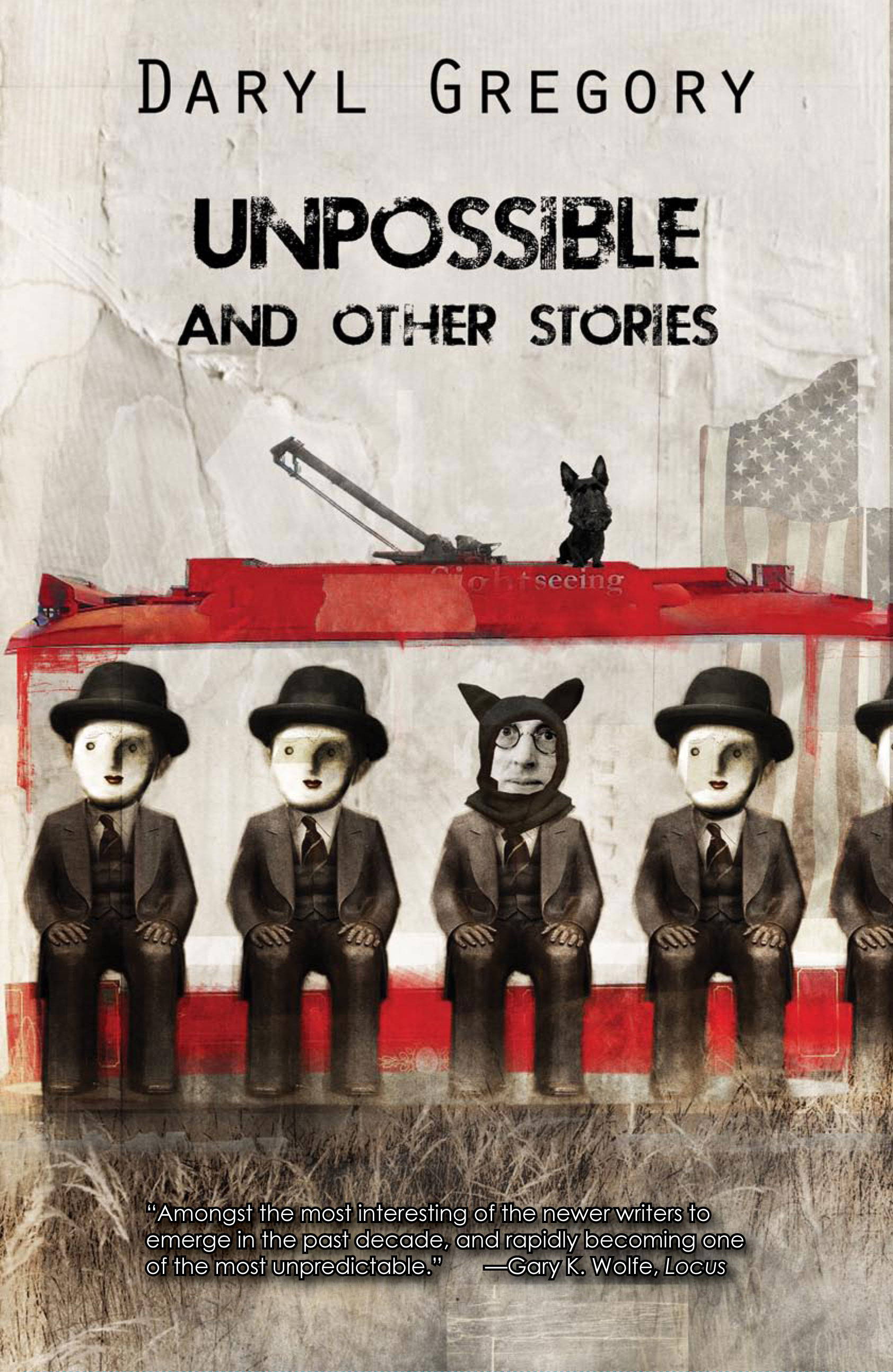
The cover, from Antonello SilveriniTomorrow I leave for my favorite con, the World Fantasy Convention in San Diego. I’ve got a couple cool things planned, most of them involving eating and drinking with good friends. SO looking forward to this.

At the con we’ll be launching Unpossible and Other Stories, my first collection of short stories, including two never-before-published shorts. I am SO proud to have an introduction from Nancy Kress, a cover by Antonello Silverini, and everything else from Patrick Swenson of Fairwood Press. The book is the usual eclectic mix of science, superheroes, and general weirdness, including the world’s only graphical sinus story.

A couple activities:

Happy Hour: On Friday, from 4-6pm, I’ll be hosting a little party to celebrate the launch of the book. Stop by if you’re in the neighborhood. I mean, come on, it’s free beer.

On Saturday at 4, I’ll be reading one of the new stories from the book, as well as reading the great underground classic from 1947, banned for years: “The Aristocrats by Isaac Asimov.”

And all through the weekend, Patrick Swenson will be at the Fairwood Press booth, selling the hell out of the book. I’ll be there to sign books, skin, affidavits…

And if you can’t make it to San Diego, you can always order online:

Direct from Fairwood Press
Amazon
Barnes & Noble

How to get someone to blurb your book

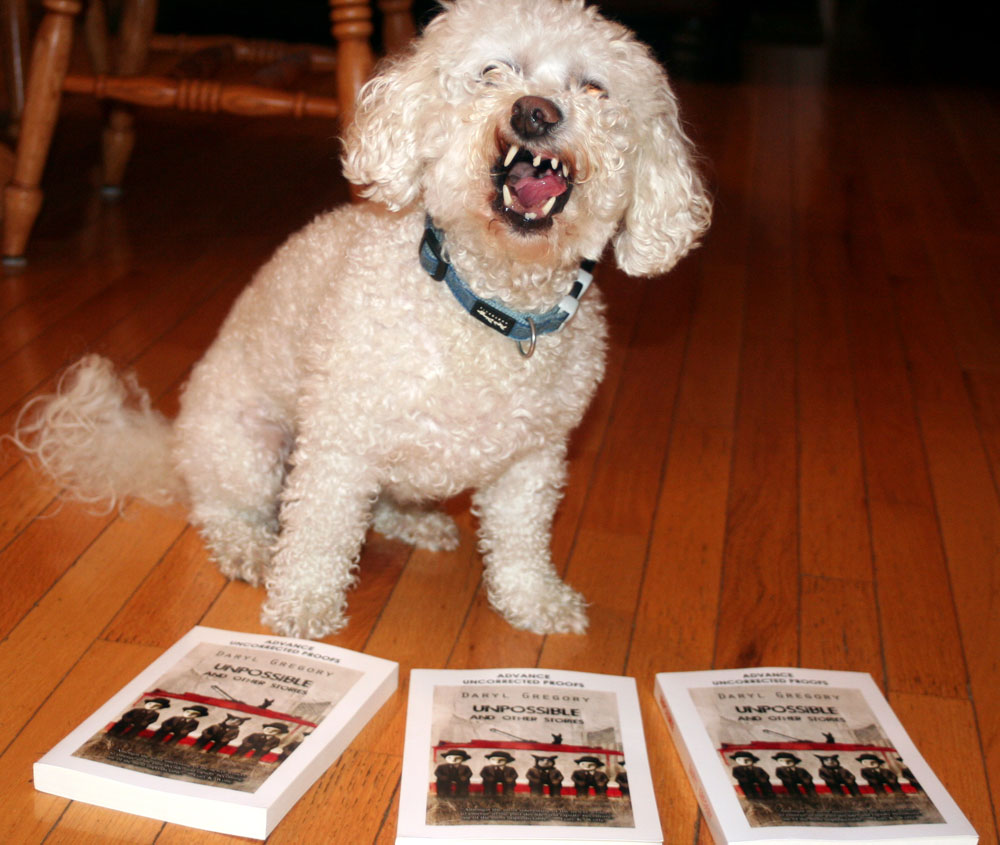
I’m about to leave for Renovation, the 2011 World SF Convention, but I received a wonderful bon voyage gift from Patrick at Fairwood Press: the advance copies of  Unpossible and Other Stories, my collection that’s coming out this Fall, and now available for pre-order.

One thing I need to do at Worldcon is find people to blurb the book.  I hate asking for blurbs.  There’s nothing like shoving your prized possession into someone’s hands and saying, “Would you please take a moment to look this over?” to make you feel like a Mormon missionary, or that homeless guy who keeps finding dead squirrels.

But that book won’t blurb itself *, so I spent the last few days practicing at home, developing a sure-fire, 3-step process for getting that blurb! And I have named it…

Daryl’s Sure-Fire 3-Step Blurb-Getting Process

Step One: Make the product attractive.

Nothing beats a full-color ARC on real paper, with beautiful art. (This cover’s by Antonello Silverini, all-around cool guy.)  How can you say no to this book? You can’t, that’s how. It’s the slutty girl you had the hots for in high school, or the hot guy you had the sluts for, and they  just invited you over to their house while their parents are away on a couples retreat at Warren Dunes, but the important thing is, the house is empty–and they have Cinemax.

And look, it's already been pre-blurbed! This tells your target what kind of top-notch quoting you expect, and that if they don't like your book, there's something wrong with them.

Step Two: Include a bonus.

One thing I’ve learned from practicing at home — keep a bunch of dog treats in your pants. Reviewers GO CRAZY for ’em. If you don’t have dog treats, substitute with a hot Panini, or beer.

Allow your target to smell the product. And, if necessary, your butt.

Step Three: Don’t take no for an answer!

If your target insists that they are too busy to read the book, simply smack them with a rolled up newspaper.

Try to find blurbers who have all their teeth.

Thank me now, fellow writers! You’re guaranteed to have as much success as me!

Stony Lives!

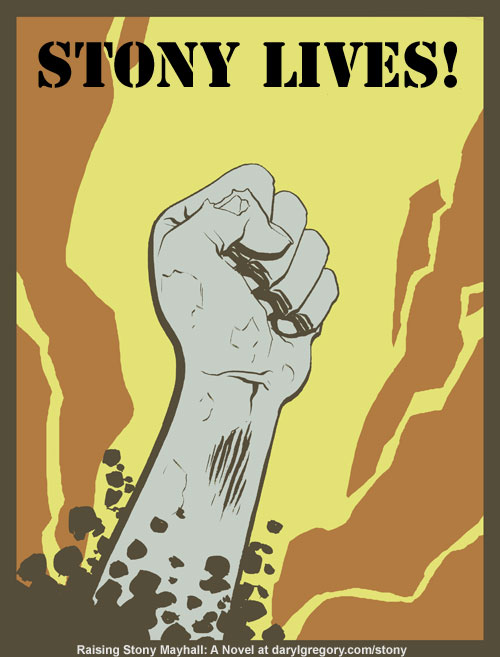
A reader of Stony wrote me and said that I ought to make “Stony Lives!” posters. So, courtesy of the amazing Scott Godlewski (the main artist behind the first comic I worked on, Dracula: The Company of Monsters), here’s a recruitment poster for The Living Dead Army.

Shall we make T-shirts?

In other zombie news…

Del Rey did a lovely thing at Comic Con: they did a massive giveaway of my first novel, Pandemonium, and I sat and signed them for an hour and a half, all as a way of fooling people into buying copies of Raising Stony Mayhall. This scheme kind of worked. Mysterious Galaxy bookstore, which had a booth next door, sold out all their copies, including the copies that Del Rey gave them. Thanks to everyone who came by. Hope you dig it.

io9 recently ran an interview with me, “Why Daryl Gregory created a zombie messiah for Raising Stony Mayhall“. Just for the record, I know how to spell “xenophobia.” But the interview was done over the phone, so that word became the phonetic equivalent “zenophobia”, which as one commenter pointed out, may be a reference to my fear of Greek philosophers. I think it’s a reference to my fear of half measures. (Ha! That’s a Zeno’s Paradox joke. I kill me.)

Faren Miller recently reviewed Stony in Locus, and it’s been posted online. It starts with this:

Raising Stony Mayhall should add to Daryl Gregory’s reputation as a dazzling innovator, despite being set in an alternate history whose starting point comes from the realm of pulpish horror: the zombie invasion in Night of the Living Dead

and ends with this:

…in the terms of literary scholars, Daryl Gregory has ‘‘deconstructed’’ the familiar zombie story, providing a self-reflective ‘‘meta’’ take on it. Fortunately for the rest of us, Raising Stony Mayhall is also a fast-paced, exciting narrative laced with both humor and moments of pathos.

So that was nice. And a while later the San Francisco Book Review  appeared:  “In short, this is a remarkable book about what it means to be alive. It’s destined to be a classic. Read it and find out why.”

I like reviews that end in commands.

Surrounded by Apes

…and we’re back.

First I disappeared to Comic-Con in San Diego, where a good time was had by me, if not all — I pity those poor folks who have to wait in line. But it was pretty cool to walk onto  the floor and see the Planet of the Apes banner hanging over the BOOM! booth. Here’s a photo taken by family friend Jean Yeatman:

And then we tacked on a family vacation that included the San Diego zoo and Disneyland, and then I came home to a lot of work that had piled up while I was gone, and then there was the whole announcement of the television thing. Boy, did that get weird, with the production company issuing denials and asking me to change my blog.

There are a bunch of things I’ve been meaning to pass on, so today I’ll do the apes stuff, and later I’ll do an update on Raising Stony Mayhall.

Continue reading

Pandemonium, the television show

UPDATE (8/4/2011): I’ve been contacted by NAME OF COMPANY of FAMOUS DIRECTOR to please not mention his name.  This, despite the fact that the news has been reported in Publisher’s Marketplace, which is read by the press, and the has been spread  all over teh internets.

So, please accept this redacted post:


Maybe. Perhaps. Probably not.

Publishers Marketplace just announced it, and Tim Pratt outed me on twitter, so I suppose I should acknowledge it here — FAMOUS DIRECTOR  (you know, that FAMOUS MOVIE TITLE guy? Who is brilliant?) and his company, NAME OF COMPANY, picked up the option for Pandemonium, with an eye toward making it into a TV show. This is just an option, the first step in a staircase of a million steps, and options that make it all the way to the small or large screen are the exception rather than the rule. The rare exception, I’ve been told.  So don’t get too excited, Mom.

And I know what you’re thinking — why can’t you just enjoy it when something positive happens? It’s in my nature to immediately pop any balloon of good news, but today I will merely deflate it a little, by inhaling its rich, helium like gasses, and then talk in a funny voice for the rest of the day.

–d

Burn Notice: The Stony Review Roundup

So, some reviews of Raising Stony Mayhall have popped into my mailbox this morning.

Library Journal gave it a star, and ended their review with this:

The author of The Devil’s Alphabet and Pandemonium has written a masterly tale of love that defies standard limits. Stony Mayhall emerges as a unique character, defined by the people who love him, at war with his own identity, and driven to create his own definition of “being human.” VERDICT Part superhero fiction, part zombie horror story, and part supernatural thriller, this luminous and compelling tale deserves a wide readership beyond genre fans. Highly recommended.

And Karen Burnham at SF Signal gave Stony a five-star review. She starts with “So where to begin? Well, let’s start with Stony, the best zombie character ever.” She discusses many of the plot elements, themes, and techniques of the book, but then says, “I don’t want to lose sight of the fact that Raising Stony Mayhall is also a lot of fun… He’s playing with the forms, asking questions that only parodists or satirists usually ask.”

And then she ends with this:

I suspect (and hope) that with the upcoming publication of Gregory’s first collection of short stories (Unpossible and Other Stories, Fall 2011), more thorough critical attention will be heading his way. More than many novelists, Gregory’s work not only withstands but grows richer with re-readings and sustained attention.

Last but not least, Kel Munger of the Sacramento News and Report. became so engrossed in Stony that he got a sunburn.

So the score this week  for those playing at home: One star, five stars, and intense solar radiation. I’m happy.

More Stony Giveaways

Over on the SF Signal website, you can win a copy of Raising Stony Mayhall just by leaving a comment.  How easy is that?

Here’s the deal. I wrote an article called Anti-Horror: A Modest Proposal for Yet Another Subgenre. It semi-seriously proposes a new branch of fantasy called anti-horror (which I’ve of course placed my novels in), and asks for other examples of books that would become canon in this new subgenre. Why not play along? All you can lose is your time, and you may win a book.